
Charter School Newsletter February 2015 |
|||
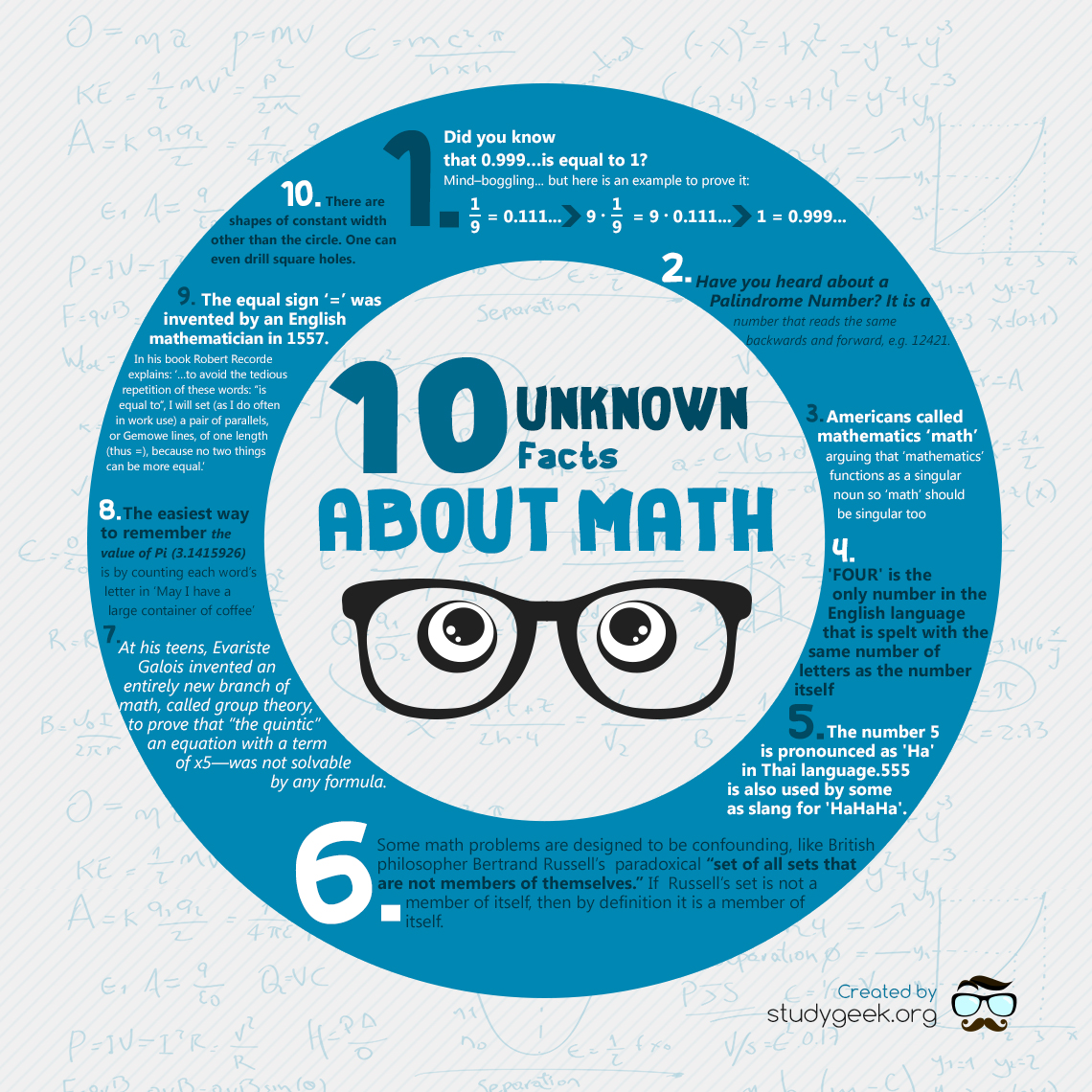
10 Unknown Facts About MathOriginally pinned from: visual.ly/10-unknown-facts-about-math
|
|
||
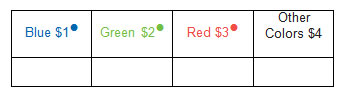
Strategy for Success: Write an easier problem and use models.Even when students can understand the words in a problem, they may find it helpful to act it out with manipulatives, real-life objects (or realia), and drawings. For example: An artist makes jewelry using beads of various colors and prices. He pays $1 each for blue beads, $2 for green, $3 for red, and $4 for all others. He designs a necklace with six blue beads, four green, and 10 red. How much does he spend on beads to make the necklace? You can give the students colored counters to model the necklace. Here is one possible design:  Make a table on the board as shown, so that the information from the problem is simplified from words into color-coded symbols:
Have students work in small groups to find the cost of the necklace and explain their process. Students will learn from each other as they work together. Auditory learners in particular will profit from the discussion as they work on the task. Visual learners benefit from “seeing,” as well as “hearing” and “doing.” If there are English language learners, have someone who speaks their language, such as a bilingual aide, work with that group. Use creative grouping among students and collaboration among teachers! Planning lessons with your school’s experts on students with special needs will give you more insights on how to reach all students in the same class. Read the full article |
Product Spotlight
The Personal Math Trainer® Powered by Knewton™ bridges formal and informal learning time, redefining digital and classroom instruction as we know it. With the ability to customize and present dynamic lessons, HMH Player™ gives teachers back valuable time. By seamlessly merging technology with curriculum, teachers are equipped with the resources needed for effective and efficient instruction. Designed for today’s digital natives, HMH Player connects students to their interactive lessons, adaptive assessments, and a variety of digital tools to maximize the amount of time students are on task both in and out of school. The app’s innovative design provides ease of use and flexibility for the teacher and student with both online and offline access to the trusted content and core curriculum programs of HMH®. Find out more about The Personal Math Trainer. |
Professional Development Corner—The Leadership and Learning CenterImplementing the CCSS Mathematical Practices Using Singapore Math Strategies and Problem Solving Structures Douglas Reeves, Rachel Syrja, and featured guest, Yeap Ban Har, discuss how to provide a firm foundation for mathematics instruction using world-class Singapore Math® strategies as well as problem-solving structures from Five Easy Steps to a Balanced Math Classroom. The balanced math program components: Step 1: Computational skills In case you missed the webinar on Implementing the CCSS Mathematical Practices Using Singapore Math Strategies and Problem Solving Structures, you can now watch it online.
|
Charter School of the MonthCamelback Academy —Glendale, Arizona.jpg)
This month’s featured Charter school is a great example of how the Charter movement is driving change in the structure by which we educate our children. Camelback Academy is the only Project CHILD School in Arizona. Project CHILD is a Grade K-5 instructional model based on cooperative learning and a triangulated learning system. Unlike a traditional school where elementary students receive a new teacher each year, students in a Project CHILD model stay with the same "cluster" of teachers for three years, first in Grades K-2 and then in Grades 3-5. Teachers become “Content Specialists” rather than generalists, and students rotate between subjects throughout the school day. Because teachers are with their students for three years, they are able to get to know both students and their families very well, fostering communication and the learning process. Additionally, the Project CHILD model takes advantage of three different learning stations to reinforce concepts as they are taught. Following an introduction of the lesson through whole group instruction, students then rotate between hands-on, paper-and-pencil, and technology stations to dive deeper into the concept and practice new skills. Curriculum is also an important part of student success at Camelback Academy. The school began using Journeys Common Core in Grades K-2 in January 2014 and immediately saw results with student achievement. Beginning in the 2014-2015 school year, Journeys was adopted in Grades 3-5 as well, with similar results. Teachers were excited to have the many effective resources for planning and delivering instruction that are a part of the program, and both writing and reading teachers were able to develop an extremely cohesive instruction plan. For math instruction, Camelback Academy uses Math in Focus which follows the Singapore method. The program has taught students to analyze numeric operations through visual models and mental practices. The rigor embedded in the curriculum has helped both teachers and students to use higher level thinking skills when deconstructing word problems and complex operations. The program has been effective at improving both student learning and teacher performance. Camelback Academy, through use of its innovative instructional model, dedicated teachers and effective curriculum, demonstrates the impact that driving change can have on today’s students. Is your school a leader? Do you have a great success story you’d like to share? Tell us about it and you could see your school featured in a future edition! |
Financial Resources to Help Your School ExcelThis month’s featured grant: Educational Grants from Dr. Scholl Foundation. In general the Foundation guidelines are broad to give them flexibility in providing grants. Applications for grants are considered in the following areas: Education, Social Service, Healthcare, Civic and Cultural, and Environmental. Average Amount Awarded: |
Monthly PollLast month’s poll results: What is your preferred style of teaching math?
This month's question: Typically, how do you first find out about new books to read in your classroom?
See how you compare next month when we reveal the poll results! |
Our Vision: From the Desk of HMH Leadership“As technology enables us to deliver educational content in new and different ways, smart and visually engaging design is more crucial than ever before in enabling an effective and delightful user experience. By applying design thinking, creativity, and problem-solving skills to create learning content driven by simplicity, connectivity, and transformation, designers enable thoughtful experiences that are intuitive and command attention.” —Morgan Curran is Vice President of the Design Studio at Houghton Mifflin Harcourt, leading a team of user experience, visual, audio visual, animation, gaming and character designers, focused on delivering next generation learning experiences for K–12 students, teachers and parents. - See more here. |